

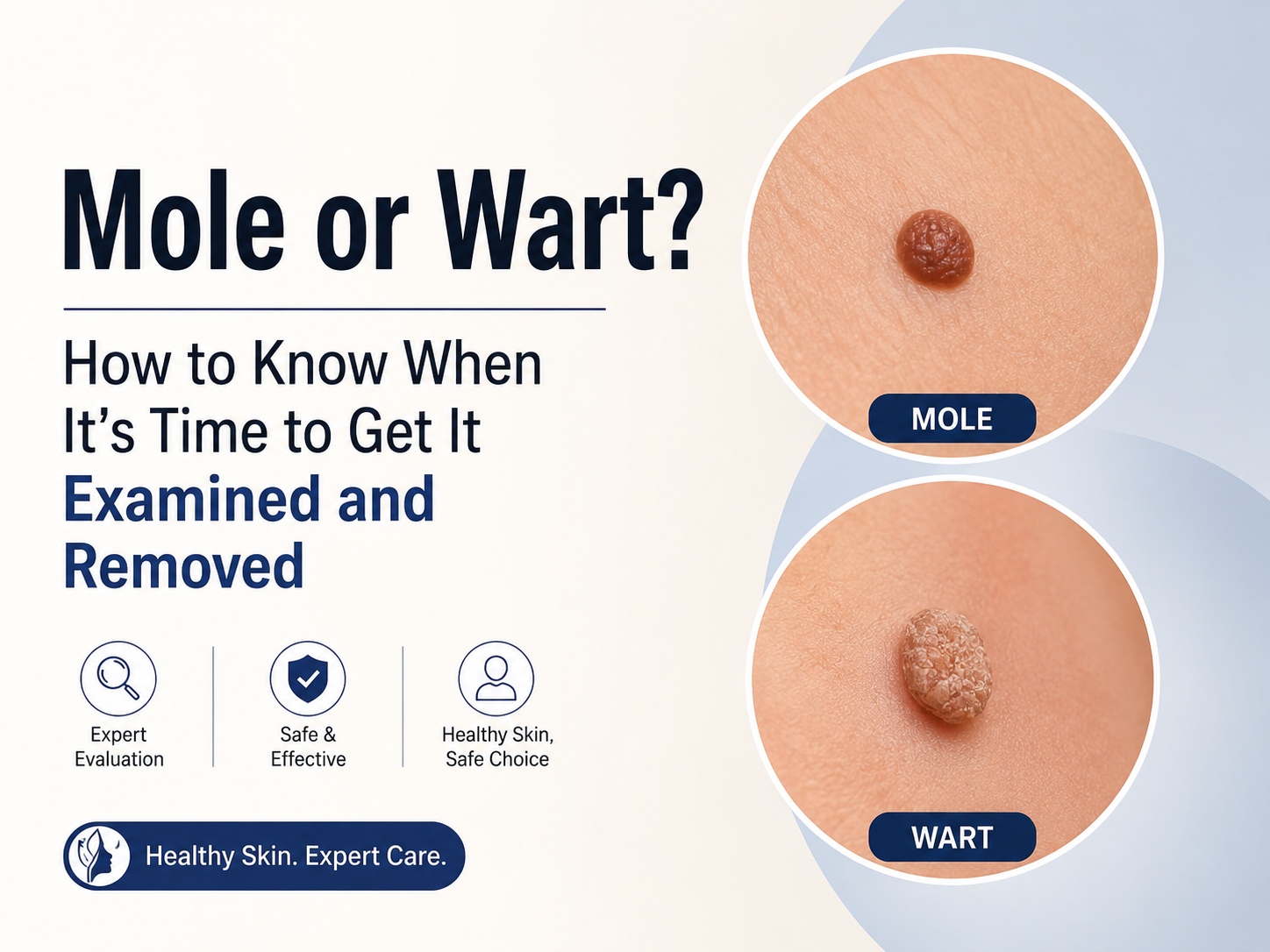
If you have a small growth on your skin that you’ve been ignoring for months, you’re not alone. Many people living in Rohini, Delhi, put off getting skin lesions checked simply because they’re unsure whether it’s a mole, a wart, or something else entirely. Mole and wart removal in Rohini Delhi is one of the most commonly requested minor procedures, and for good reason — knowing what’s growing on your skin, and whether it needs attention, is a straightforward step toward both peace of mind and better health.
Mole vs. Wart: Understanding the Difference
Before deciding on any action, it helps to understand what you’re actually dealing with. Moles and warts may look similar to the untrained eye, but they have very different origins, appearances, and implications.
What Is a Mole?
A mole, medically known as a melanocytic nevus, is a cluster of pigment-producing cells (melanocytes) in the skin. Most moles are:
- Brown, black, or skin-coloured
- Flat or slightly raised
- Round or oval with a well-defined border
- Present from birth or developed during childhood and early adulthood
- Typically smaller than 6 mm in diameter
Most moles are completely harmless. However, a mole that changes in size, shape, colour, or texture deserves prompt professional evaluation.
What Is a Wart?
A wart is a viral skin infection caused by certain strains of the Human Papillomavirus (HPV). Unlike moles, warts:
- Have a rough, cauliflower-like or grainy surface
- Can appear anywhere on the body, but are common on hands, feet, and fingers
- Are contagious and can spread through direct contact or shared surfaces
- May have tiny black dots at their centre (clotted blood vessels)
- Can disappear on their own over time, though this can take months or years
Because warts are viral, they require a different treatment approach than moles.
Warning Signs That Demand a Professional Examination
Not every mole or wart needs immediate removal, but certain signs should never be ignored. Dermatologists use the ABCDE rule to evaluate moles for potential melanoma:
- A – Asymmetry: One half of the mole doesn’t match the other.
- B – Border: The edges are irregular, ragged, notched, or blurred.
- C – Colour: The colour is uneven, with shades of brown, black, red, white, or blue.
- D – Diameter: The mole is larger than 6 mm (about the size of a pencil eraser).
- E – Evolving: Any change in size, shape, colour, or a new symptom such as bleeding or itching.
For warts, seek professional evaluation if:
- The wart is spreading rapidly or multiplying
- It becomes painful, bleeds, or changes in appearance
- It is located on the face, genitals, or near the eyes
- You are unsure whether the growth is a wart or something more serious
- Over-the-counter treatments have failed after several weeks
- You have a weakened immune system
When Should You Consider Removal?
Removal isn’t always medically necessary, but it is frequently recommended or preferred in specific situations.
Medical Reasons for Removal
- Suspicious appearance: Any lesion showing ABCDE warning signs warrants a biopsy or removal for histological analysis.
- Persistent irritation: A mole located where it’s repeatedly rubbed by clothing, jewellery, or shaving can become inflamed and should be removed.
- Rapid change: A mole or wart that grows quickly over weeks or months needs prompt evaluation.
- Infection risk: Warts that crack or bleed can become entry points for bacterial infections.
Cosmetic or Quality-of-Life Reasons
There is nothing trivial about seeking removal for cosmetic or comfort reasons. Many people choose removal when a mole or wart:
- Affects their self-confidence, particularly on the face or neck
- Catches on clothing or accessories repeatedly
- Is in a location that causes discomfort during daily activities
- Has been present for years without resolving on its own
A qualified dermatologist or cosmetic surgeon can assess whether removal is appropriate and which technique is best suited to your skin type and the nature of the lesion.
Mole and Wart Removal: Common Methods Used in Minor Procedure Clinics
Modern dermatology offers several safe, minimally invasive options for removing moles and warts. The method chosen depends on the type, size, location, and depth of the lesion.
Radiofrequency (RF) Ablation
One of the most widely used techniques for raised moles and warts. A radiofrequency current precisely vaporises the tissue with minimal surrounding skin damage. It is well-suited to facial lesions because it leaves very little scarring.
Cryotherapy
Liquid nitrogen is applied to the wart, freezing and destroying the infected tissue. It is particularly effective for common warts on hands and feet and typically requires one to three sessions.
Laser Treatment
Laser energy targets pigmented cells in moles or destroys the blood supply feeding a wart. It is precise, relatively bloodless, and works well for flat moles and certain wart types.
Surgical Excision
For deeper moles or lesions suspected to be malignant, surgical excision with or without stitches is the standard approach. The removed tissue is sent for pathological examination, which provides a definitive diagnosis.
Electrocautery
An electric current is used to burn off the lesion. Effective for small, superficial warts and moles, this method is quick and can be performed under local anaesthesia in a clinical setting.
What to Expect During and After the Procedure
Most mole and wart removal procedures at minor procedure clinics are completed within 15 to 30 minutes under local anaesthesia. Here is a general outline of the experience:
Before the procedure:
- A dermatologist examines the lesion and may perform a dermoscopy (a magnified skin examination) to assess its nature.
- You will discuss the most appropriate removal technique.
- The area is cleaned and a local anaesthetic is applied.
During the procedure:
- The actual removal takes only a few minutes and is generally painless due to the anaesthetic.
- A light dressing is applied afterwards.
After the procedure:
- Mild redness, swelling, or a small scab is normal and usually resolves within one to two weeks.
- Sun protection over the treated area is essential to prevent post-inflammatory hyperpigmentation, especially important for people with medium to darker skin tones common in North India.
- Most people return to normal activities the same day.
- If tissue was sent for biopsy, results are typically available within one to two weeks.
Choosing a Clinic for Mole and Wart Removal in Rohini
Rohini is one of Delhi’s largest residential districts, and access to qualified dermatological care has grown significantly in recent years. When selecting a clinic or practitioner, consider the following:
- Qualifications: Ensure the doctor is a certified dermatologist (MD Dermatology) or a qualified cosmetic or plastic surgeon.
- Dermoscopy availability: A clinic that uses dermoscopy before removal demonstrates a commitment to accurate diagnosis, not just aesthetic results.
- Biopsy protocol: If a mole looks unusual, the clinic should send the excised tissue for histopathology rather than simply discarding it.
- Aftercare guidance: Good clinics provide clear post-procedure instructions and a follow-up appointment.
- Hygiene standards: For a procedure that involves breaking the skin, sterilisation and infection control practices are non-negotiable.
Frequently Asked Questions
Is it safe to remove a mole or wart at home?
Over-the-counter products exist for wart removal and may work for common, non-facial warts. However, attempting to remove moles at home — by cutting, tying, or applying caustic substances — is strongly discouraged. It can cause scarring, incomplete removal, and, critically, it prevents the lesion from being properly examined. Always consult a dermatologist for moles and for any wart in a sensitive location.
Will the removal leave a scar?
Scarring depends on the technique used, the size and depth of the lesion, and your skin’s healing tendency. Radiofrequency ablation and laser treatments typically leave minimal to no visible scarring for superficial lesions. Surgical excision may leave a fine linear scar that fades significantly over several months. Your doctor will discuss the likely cosmetic outcome before the procedure.
How do I know if my mole is cancerous?
Only a dermatologist can make a definitive assessment, and even then, a biopsy is often needed for certainty. The ABCDE rule (Asymmetry, Border, Colour, Diameter, Evolving) gives you a useful self-check framework, but it is not a substitute for professional evaluation. If you have any doubt, book an appointment rather than waiting.
Can a wart come back after removal?
Yes, because warts are caused by the HPV virus, and the virus can remain dormant in surrounding skin even after the visible wart has been removed. Recurrence is more likely in people with compromised immunity or in high-friction areas. Maintaining good hygiene, avoiding sharing personal items, and keeping the skin healthy reduces the likelihood of recurrence.
How many sessions are needed to remove a wart completely?
It depends on the method and the size of the wart. Cryotherapy often requires two to three sessions spaced two to three weeks apart. Laser treatment or radiofrequency ablation may resolve the wart in a single session. Your dermatologist will give you a realistic treatment timeline after examining the wart.
Conclusion
Moles and warts are among the most common skin concerns, yet they are also among the most misunderstood. Knowing the difference between the two, recognising warning signs that warrant prompt evaluation, and understanding the safe, effective removal options available can make a meaningful difference in both your skin health and your confidence. If you have a growth that has changed, is causing discomfort, or simply makes you uneasy, the sensible step is a consultation with a qualified dermatologist. Minor procedures for mole and wart removal in Rohini Delhi are accessible, quick, and — when performed by a trained professional — both safe and effective.
🌐 Visit our website:
https://oswaljainskinclinic.com/
📖 Explore more expert articles:
https://oswaljainskinclinic.com/