
Hair loss treatment has changed significantly in recent years. Along with medicines and conventional hair-care approaches, regenerative treatments such as PRP and growth factor therapy are increasingly discussed for people experiencing hair thinning and certain types of hair loss.
But what is the difference between PRP and growth factor therapy? Is one better than the other? And how do you know which treatment may be suitable for you?
The answer is not the same for everyone. Both approaches are designed to support the hair follicles, but they use different preparations and treatment protocols. Current research shows promising results for both, while also highlighting differences in how these treatments are prepared and delivered.
What Is PRP Hair Treatment?
PRP stands for Platelet-Rich Plasma.
In PRP therapy, a small amount of your own blood is collected and processed to separate the plasma containing a higher concentration of platelets. This platelet-rich preparation is then injected into selected areas of the scalp.
Platelets contain several growth factors and signaling proteins that may support processes involved in hair follicle activity and tissue repair.
The procedure is generally minimally invasive and usually does not require significant downtime. The American Academy of Dermatology describes PRP as a treatment that may help reduce hair loss and promote hair thickening or regrowth in appropriate patients.
However, PRP is not suitable for every type of hair loss. The underlying cause should be assessed before treatment.
What Is Growth Factor Therapy for Hair Loss?
Growth factor therapy refers to treatments that use preparations containing growth factors or signaling proteins intended to support hair follicle activity.
Unlike conventional PRP, which is prepared from the patient’s own blood, some growth factor treatments use specially prepared concentrates or formulations. The exact composition can vary significantly depending on the technology and protocol used.
This is an important point because “growth factor therapy” is not one single standardized treatment. Different clinics and studies may use different preparations, concentrations and injection protocols.
A 2026 systematic review of growth factor injections for androgenetic alopecia found improvements in hair density and thickness, but also reported substantial differences between studies and limitations in the quality of available evidence.
PRP vs Growth Factor Therapy: What Is the Main Difference?
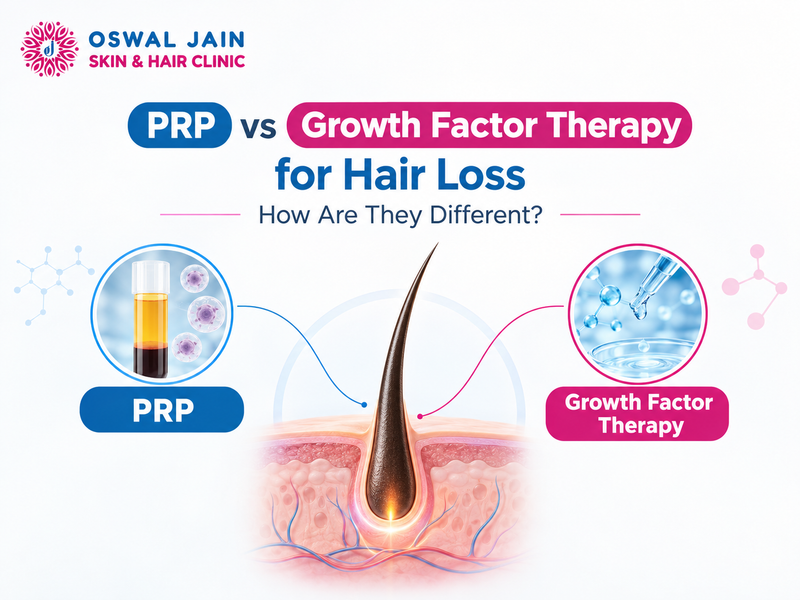
The simplest way to understand the difference is to look at what is being injected.
PRP:
Uses a preparation made from the patient’s own blood, with platelets and naturally occurring growth factors concentrated from that blood.
Growth factor therapy:
May use a more specifically prepared growth factor concentrate or regenerative formulation, depending on the treatment technology.
Both approaches aim to support the hair follicle environment, but they are not necessarily identical treatments.
| Feature | PRP | Growth Factor Therapy |
|---|---|---|
| Source | Patient’s own blood | Depends on the specific formulation |
| Main components | Platelets, plasma and growth factors | Selected/concentrated growth factors or signaling proteins |
| Preparation | Blood is collected and processed | Preparation varies by technology |
| Evidence | Relatively well studied | Growing but less standardized |
| Protocol | Varies between clinics | Can vary substantially |
| Suitability | Depends on diagnosis | Depends on diagnosis and treatment formulation |
Because protocols differ, comparing the two only by the treatment name can be misleading.
How Does PRP Work for Hair Loss?
The goal of PRP is to deliver a concentrated platelet preparation into areas affected by hair thinning.
The growth factors released from platelets may influence processes involved in follicular activity, blood-vessel formation and the hair-growth environment.
Recent research continues to investigate how PRP may support hair density and thickness in androgenetic alopecia. A 2026 review described PRP as a promising minimally invasive option but also noted that differences in preparation, activation and delivery methods can contribute to inconsistent outcomes.
This means the response can vary from one person to another.
How Does Growth Factor Therapy Work?
Growth factor therapy aims to provide signaling molecules that may influence the activity of hair follicles.
Growth factors are involved in biological processes such as tissue repair, cell communication and blood-vessel formation. Researchers are studying whether delivering selected growth factors to the scalp can help support weakened or miniaturized follicles.
A 2026 meta-analysis found that growth factor concentrates were associated with improvements in hair density and thickness in androgenetic alopecia. However, the researchers also highlighted high variability between studies and a need for larger, better-standardized clinical trials.
Therefore, promising results should not be interpreted as a guarantee of hair regrowth for every patient.
Which Is Better: PRP or Growth Factor Therapy?
There is no universal answer that PRP is better than growth factor therapy, or vice versa.
The appropriate choice depends on the diagnosis, stage of hair loss, scalp condition, hair density, treatment history and the specific formulation being offered.
Importantly, a 2026 systematic review found that differences in preparation and treatment protocols make direct comparisons difficult.
A recent randomized clinical trial in women with female pattern hair loss also found differences among PRP, injectable PRF and concentrated growth factor treatments, but this does not mean that one regenerative treatment is universally superior for all patients or all forms of hair loss.
The right question is therefore not simply “Which treatment is stronger?”
It is “Which treatment is appropriate for my type of hair loss?”
Who May Be Suitable for PRP or Growth Factor Therapy?
These treatments may be considered for selected patients with certain types of hair thinning, particularly androgenetic or pattern hair loss.
However, hair loss can have many causes.
It may be associated with:
- Hereditary or pattern hair loss
- Nutritional deficiencies
- Hormonal changes
- Thyroid problems
- Stress or illness
- Certain medications
- Scalp conditions
- Autoimmune conditions
- Hair-pulling or traction
- Other medical causes
A dermatologist should first identify the likely cause before deciding whether a regenerative treatment is appropriate. The American Academy of Dermatology emphasizes that different types of hair loss require different treatments.
How Many Sessions Are Usually Needed?
There is no single treatment schedule that applies to every patient.
PRP studies use different numbers of sessions, intervals and preparation methods. The same is true for growth factor treatments.
For example, published PRP protocols may involve several initial sessions followed by maintenance treatment. The AAD notes that patients receiving PRP may return for repeated injections during the first few months and then receive maintenance sessions at longer intervals.
Your dermatologist may modify the schedule depending on your diagnosis and response.
Are PRP and Growth Factor Therapy Permanent?
Neither treatment should be presented as a guaranteed permanent cure for hair loss.
If the underlying condition is progressive, such as androgenetic alopecia, continued management may be needed even after improvement.
The goal may be to reduce hair shedding, support existing follicles, improve hair density or thickness, and maintain results as part of a broader hair-loss treatment plan.
Long-term evidence is still developing, particularly for newer growth factor formulations. Current research supports further standardized studies before making strong claims about long-term superiority.
What Should You Check Before Choosing a Hair Treatment?
Before choosing PRP or growth factor therapy, ask:
What is causing my hair loss?
Treatment should begin with diagnosis rather than simply selecting a procedure.
Which treatment is being recommended and why?
Ask your dermatologist to explain how the treatment relates to your specific condition.
What preparation is being used?
This is particularly important with growth factor-based treatments because formulations and protocols can differ.
How many sessions might I need?
Ask about the initial treatment schedule and whether maintenance may be required.
What results are realistic?
A good consultation should explain expected improvement rather than promise guaranteed regrowth.
Frequently Asked Questions
1. Is PRP better than growth factor therapy for hair loss?
There is no universal answer. Both treatments have shown potential in selected patients, but protocols vary and current evidence does not establish one treatment as universally superior. A dermatologist should select treatment according to the cause and pattern of hair loss.
2. What is the difference between PRP and growth factor therapy?
PRP is prepared from the patient’s own blood and contains concentrated platelets and naturally occurring growth factors. Growth factor therapy may use a more specifically prepared growth factor concentrate or formulation, depending on the technology used.
3. Can PRP and growth factor therapy regrow lost hair?
They may help improve hair density or thickness in selected types of hair loss, particularly some cases of androgenetic alopecia. However, results vary and neither treatment guarantees complete hair regrowth.
4. How many PRP or growth factor sessions are required?
The number of sessions depends on the treatment protocol, diagnosis and individual response. Multiple sessions are commonly used, and maintenance treatment may sometimes be recommended.
5. Should I get PRP or growth factor therapy without a hair-loss diagnosis?
It is better to have your hair loss evaluated first. Hair loss has many possible causes, and a regenerative procedure may not address the underlying problem if the diagnosis is incorrect.
Recommended Internal Links
For stronger internal linking and topical relevance, add these links naturally within the article:
- Hair Loss Treatment in Rohini → https://oswaljainskinclinic.com/treatments/hair-treatments/hairloss/
- Dandruff Treatment → https://oswaljainskinclinic.com/treatments/hair-treatments/Dandruff/
- Dr. Varun Jain – Dermatologist in Rohini → https://oswaljainskinclinic.com/
Final Takeaway
PRP and growth factor therapy are both regenerative approaches being studied and used for selected hair-loss concerns, but they are not exactly the same treatment.
PRP uses a preparation derived from your own blood, while growth factor therapy can involve more specifically prepared growth factor concentrates or formulations. Current research shows potential benefits from both, but differences in preparation, protocols and study quality make direct comparisons difficult.
If you are experiencing hair thinning or increased hair fall, the first step should be identifying the cause. Based on your diagnosis, a dermatologist can explain whether PRP, growth factor therapy, medication, or another approach is appropriate.
At Oswal Jain Skin & Hair Clinic in Rohini, consult Dr. Varun Jain for a personalized evaluation of your hair and scalp concerns.
Book a consultation to understand the cause of your hair loss and choose a treatment plan based on your individual needs.